Her Blue Body Her Blue Body Warsan Shire
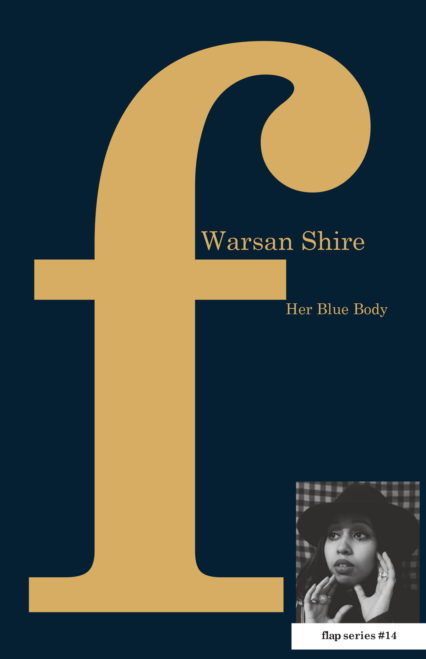
Bethany W. Pope casts a critical eye over the latest poetry drove from Warsan Shire, Her Blue Torso.
Warsan Shire'due south new pamphlet Her Blue Body is a prolonged meditation on the twinned natures of sex and decease spoiled only by an introduction (written past the Head of Arts and Civilisation for The Queen Elizabeth Park and London Legacy Development Corporation) which seems more interested in praising the sagacity of the funding bodies than it is in the work presented by the poet. Adriana Marques writes, 'Information technology is hard to write any words that feel acceptable in preface to those that follow by Warsan Shire, so the least nosotros can do is tell one story of how they got here.' What follows this exceedingly awkward sentence are nearly 2 pages of give thanks-you'due south to diverse business, corporations, and (occasionally) people who helped fund the park.
Once the reader has maneuvered through (or, preferably, skipped) the introductory mire s/he is greeted by a series of rather lovely poems which centre around relationships, friendships, sex, rape, and the sorrowful blue shadow of encephalon-cancer. 'Midnight in the Foreign Food Aisle' is written in the form of a letter to an uncle who has sacrificed his connectedness to his civilisation for sex with exotic blonde women:
Honey is not haram, merely after years of fucking
women who cannot pronounce your name,
you notice yourself in the foreign food aisle,
abreast the turmeric and the saffron of mothers' easily,
pressing your face into the ground, praying
in a language y'all haven't used in years.
This verse form is aroused, visceral, and a little redemptive. There is a special kind of loneliness in going to bed
with someone who cannot be bothered to learn your name, a certain desperation in trolling supermarket shelves for sigils from home, and Shire captures both perfectly.
The nigh engaging verse form in the pamphlet was 'The House'. The thought of a house equally a symbol for the body is both obvious and old, merely Warsan Shire manages to swerve admirably away from cliché. Each section
of the sequence represents a take on the trope of body-as-dwelling and while some of them are tender, a nifty many are startlingly tearing. In 'viii' the speaker incorporates the men who touch her, literally trapping them in miniature inside of her trunk. She writes, 'I treat them well enough, a piece of bread, if they're lucky a slice of fruit.' Only those fed, kept men were all encouraged, or at least invited. One is different:
Except for Johnny with the blueish eyes, who picked my locks and crawled in. Featherbrained boy chained to the basement of my fears. I play music to drown him out.
There is a lot of sexual practice in this book, but nigh all of the dear is played out through female friendships. In 'St Thomas' Hospital' the poet writes about receiving a terrifying diagnosis:
The doctor points to a minor dark spot.
We found claret in your encephalon
right here. I recollect of Yosra's mitt in mine
walking out of this life together,
like ii friends should.
The spectre of death is less terrifying, with a friend past your side, than the nearly vigorous sex with a body who will ever be a stranger to you.
At that place are flaws in Warsan Shire'southward work. She could utilise a meliorate editor; there were a few rough sentences, a few superfluous lines, but her potential is extremely potent and the things she does well are powerful. Currently, she's working on her starting time full collection. I look forward to reading it.
Her Blue Trunk is available from Flipped Eye Publishing.
Bethany W. Pope is a writer of fiction and poetry and a correspondent for Wales Arts Review.
Source: https://www.walesartsreview.org/poetry-her-blue-body-by-warsan-shire/
0 Response to "Her Blue Body Her Blue Body Warsan Shire"
Post a Comment